Is Deer Hunting Ethical in Hawaii? Here’s What to Know
People ask us this more than you might expect. And it's a fair question. Is deer hunting ethical in Hawaii….actually?
We get it. Hunting is a topic that carries real weight for a lot of people, and Hawaii's image as a
place of natural beauty makes the question feel sharper. At Kaluakoi Outfitters, we've hunted this land on Molokai for generations. We believe the evidence answers the questions of why we hunt axis deer and if it is ethical, and we want to walk you through it.
How Axis Deer Arrived in Hawaii and Why That History Matters
Axis deer are not native to Hawaii. That fact matters more than most people realize.
In 1867, eight axis deer arrived on Molokai as a gift to King Kamehameha V, brought from India. Three bucks, four does, and one male fawn. The original intent was recreational hunting. What no one could have predicted was how thoroughly those eight animals would reshape an island ecosystem that had evolved for millions of years without a single hoofed grazer.
Hawaii's native plants never developed thorns, toxins, or other defenses against browsing animals. They had no reason to. Axis deer walked into a landscape with no resistance and no predators, and they did what unchecked populations always do.
From Royal Gift to Ecological Problem
Today, Molokai is home to tens of thousands of axis deer. Some estimates put the island's population at 40,000 or more. That means there are roughly ten deer for every human resident on the island.
These aren't just numbers on a report. The impact shows up in stripped hillsides, in soil that washes into the ocean after rain, and in native plant communities that can no longer regenerate because deer browse every new shoot before it has a chance to grow. The deer aren't doing anything wrong. They're simply animals without limits in a place that was never built to hold them.
What Axis Deer Actually Do to the Land on Molokai
The ecological damage is specific and well-documented. Axis deer overgraze native vegetation, which leaves the soil exposed. Exposed soil erodes. On an island like Molokai, that eroded soil runs into streams and eventually into the ocean, where it damages coral reefs.
Local farmers deal with crop losses every year. Native forests lose ground. Species that depend on healthy understory vegetation lose habitat.
The deer also breed year-round, unlike most mainland deer species. Without natural predators to slow reproduction, the population compounds quickly. The Hawaii Division of Forestry and Wildlife has estimated that managers would need to remove roughly 30 percent of the population annually just to keep numbers stable.
That's not a small ask. It can't be done through fencing alone.
Why Hunting Is the Most Effective Tool for Axis Deer Population Control
Fencing works on small, specific plots of land. It's expensive to install, difficult to maintain across Molokai's varied terrain, and it doesn't reduce the deer population. It just redirects it.
The Hawaii Department of Land and Natural Resources and the Department of Hawaiian Home Lands have both recognized that regulated hunting is the primary tool available for managing axis deer numbers. In 2024, the two agencies partnered to open previously off-limits lands on Maui to legal hunting specifically to control axis deer damage. The state is not pushing hunting as recreation. It's pushing hunting as land management.
On Molokai, that logic has been in place for much longer. Hunting here is a recognized method of population control, and it's one that produces a tangible, usable result.
Is Deer Hunting Ethical in Hawaii? Is it Legal?
Yes and yes.
On private land on Molokai, axis deer have no closed hunting season. You can hunt year-round. Hawaii courts have also recognized axis deer hunting as a traditional subsistence practice that predates 1892, which means it carries legal standing alongside other protected cultural practices.
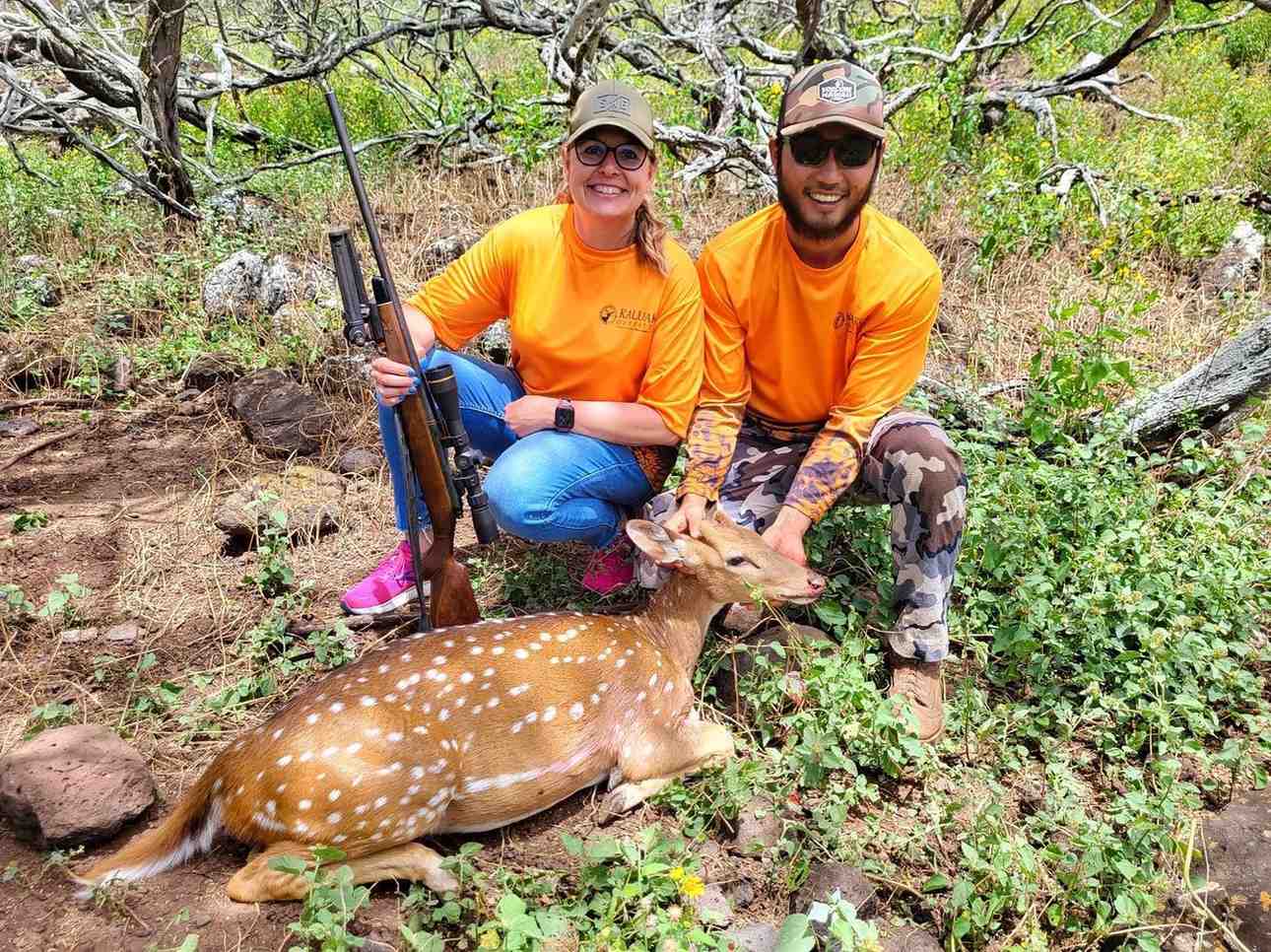
At Kaluakoi Outfitters, each hunter is allowed two animals: one management buck under 27 inches and a doe, or two does. A trophy fee applies if a buck measuring 27 inches or greater is harvested. Firearms must stay unloaded except when in use. Hunter orange is required in the field. Caliber below .223 is not permitted.
These aren't suggestions. They're enforced on every hunt. We also have a target range on the property, available to 600 yards, so your rifle is zeroed before you step into the field.
How Kaluakoi Outfitters Runs Ethical, Guided Deer Hunts on Molokai
At Kaluakoi Outfitters we offer fully guided hunts. You don't go out alone, and you don't guess. Your guide knows the 3,000 acres of private ground we operate on. They know where the deer move, how the wind behaves across different parts of the property, and how to put you in a position for a clean, ethical shot.
After the harvest, your guide handles field processing on the spot. You don't have to figure it out yourself.
Is deer hunting ethical in Hawaii when it's done this way? We believe the answer is yes, and not just because of the conservation argument. It's ethical because every animal is treated with respect, every harvest serves a purpose, and the land is managed with the intention of leaving it better than we found it.
Book a Responsible Deer Hunt With Kaluakoi Outfitters on Molokai